
Multimodal Event Analytics Platform
A unified enterprise AI platform for creating, training, deploying and managing event analytics scenarios across video, audio, sensors, VMS and enterprise systems.
- Turns isolated CV modules into a single intelligent event analytics layer
- Combines Computer Vision, Speech Analytics, LLM, VLM, Generative AI and low-code scenario orchestration
- Enables users to create new AI scenarios from natural-language task descriptions
From Natural Language Task to Deployed AI Scenario
The core idea of the platform is simple: the user describes the monitoring task in natural language — the platform automatically builds the AI pipeline, prepares data, creates the scenario and deploys analytics to cameras and infrastructure.
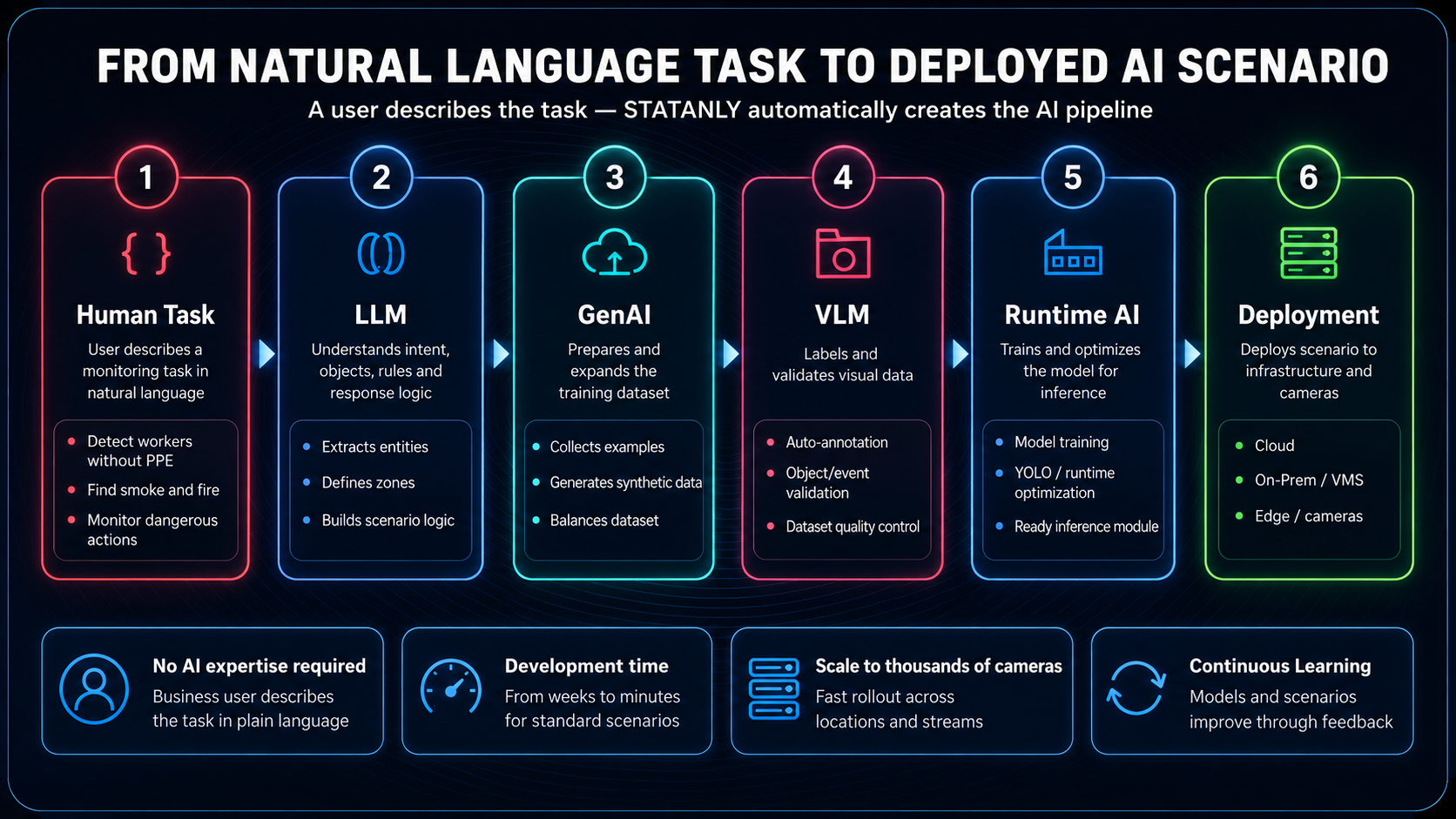
The user does not need AI expertise: STATANLY turns a business request like “detect workers without helmets” or “find smoke and fire” into data preparation, model creation, scenario logic and deployment.
Core Components of the Platform
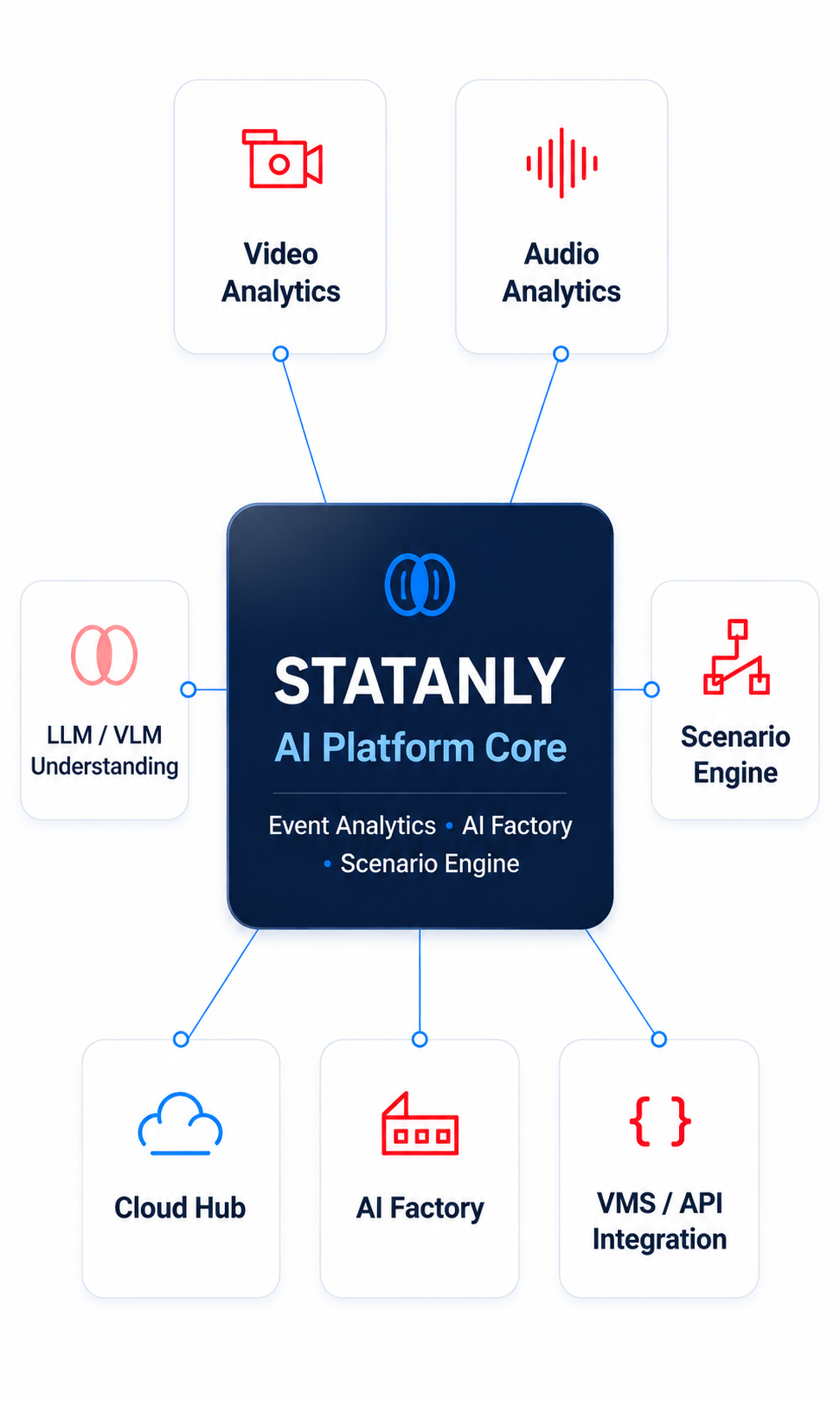
STATANLY is not just a set of detectors. It is a full platform layer for creating and operating AI event analytics across enterprise infrastructure.
Multimodal Event Analytics
Video streams, audio, sensors and metadata are processed together to detect events, violations, operational risks and process deviations.
Scenario Engine
Low-code orchestration layer for zones, triggers, rules, schedules, escalation logic, notifications and multi-event scenarios.
AI Factory
Tools for collecting data, annotating datasets, generating synthetic examples, training models and managing model versions.
LLM / VLM Layer
Natural-language task interface and visual-language understanding for converting business intent into AI scenarios and datasets.
Cloud Hub
Centralized management of models, licenses, scenarios, analytics, reporting, multi-site operations and deployment workflows.
On-Prem Runtime
Local AI processing inside the enterprise perimeter with support for GPUs, VMS integration, edge nodes and secure infrastructure.
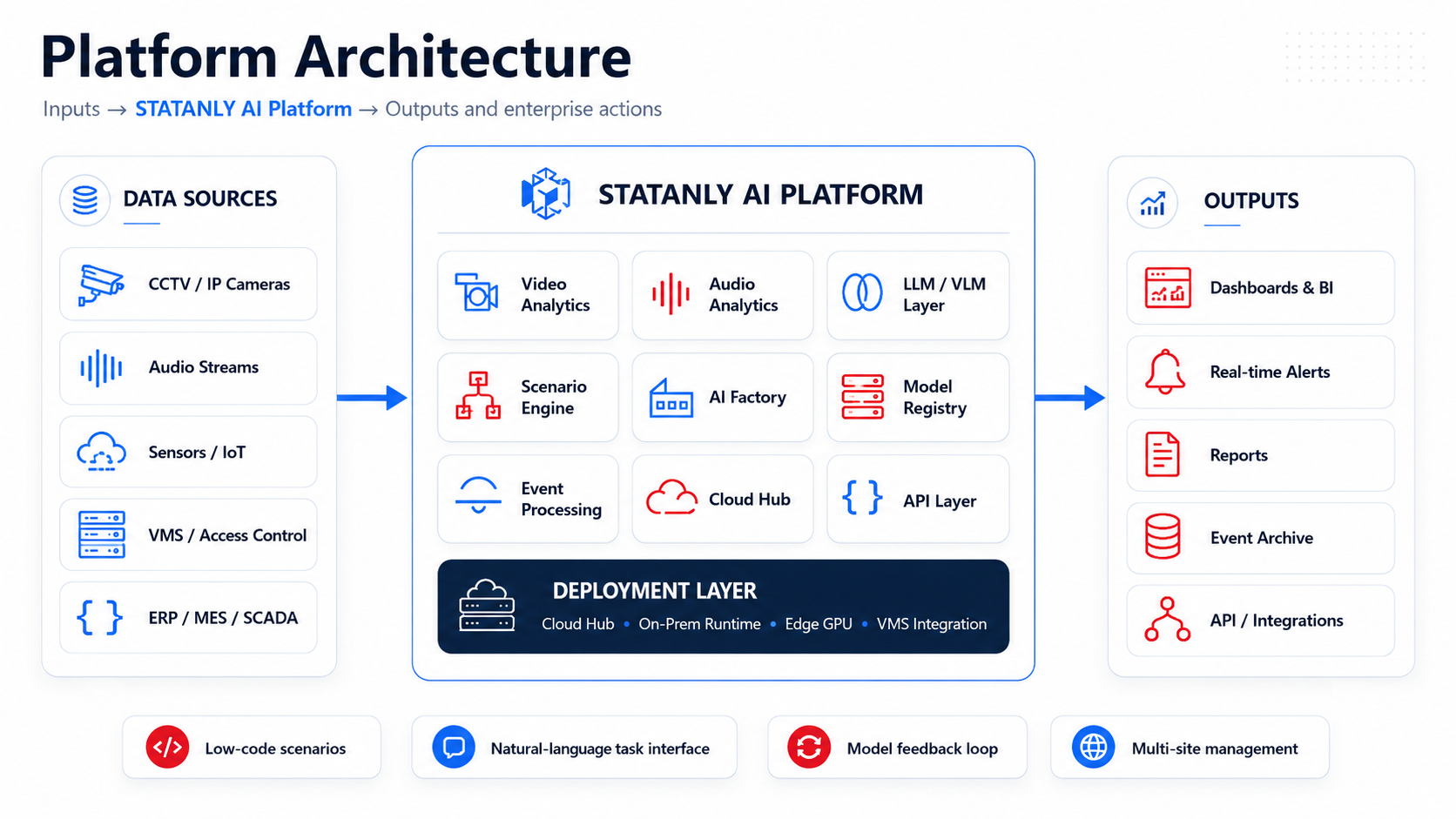
Unified Architecture for Inputs, AI Processing and Outputs
The platform connects existing cameras, microphones, sensors, VMS and enterprise systems into one AI operating layer that generates events, alerts, reports, dashboards and integrations.
Continuous Creation and Improvement of AI Models
AI Factory is the internal loop that allows the platform to create new models, improve existing ones and adapt analytics to specific customer environments, objects and camera angles.
AI Factory
The platform combines real data, synthetic generation, VLM-assisted labeling, model training and feedback loops into a repeatable process for building new AI scenarios faster.
Data Collection
Collect examples from cameras, archived events, customer data and controlled test environments.
Synthetic Data
Generate rare or hard-to-capture cases to improve robustness and reduce model launch time.
VLM Labeling
Use vision-language models for object understanding, pre-labeling and dataset validation.
Training
Train and fine-tune AI models for specific events, sites, industries and camera conditions.
Model Registry
Store model versions, metrics, scenarios and deployment configurations in one controlled system.
Feedback Loop
Use real incidents, false positives and operator validation to improve models continuously.
Typical AI Scenarios Created on the Platform
The same platform foundation can be used to create simple and complex event analytics scenarios across industrial safety, operations, logistics, retail, HoReCa and infrastructure.
PPE Detection
Detect missing helmets, vests, masks, gloves, glasses and other required protective equipment.
Violation Detection
Detect unsafe behavior, restricted area access, perimeter breaches and policy violations.
Fire & Smoke Detection
Recognize smoke, fire and emergency events in production, warehouses and public spaces.
Phone Usage
Control phone usage and distractions in prohibited industrial or operational zones.
People Counting
Analyze occupancy, customer flow, queues, crowd density and workload across locations.
Process Monitoring
Monitor equipment, production processes, operational bottlenecks and abnormal events.
Deployment for Enterprise Infrastructure
STATANLY supports cloud, secure on-premise, edge and hybrid architectures, making it possible to deploy AI analytics across one site, a distributed network or thousands of camera streams.
Cloud Hub
Centralized management of scenarios, models, analytics, licenses, events and multi-site reporting.
On-Prem
Local processing inside the customer infrastructure for data sovereignty and enterprise security requirements.
Edge Runtime
Low-latency AI inference near cameras or sites to reduce traffic and server requirements.
VMS Integration
Connection to existing video systems, IP cameras, RTSP, ONVIF, event streams and metadata.
Platform impact: faster creation of AI scenarios, unified event analytics instead of isolated detectors, continuous model improvement and scalable deployment across enterprise sites and camera networks.